
On September 2, the Bank of Canada left its policy rate unchanged at 2.25% for the seventh meeting in a row. The hold itself was about as surprising as traffic on the 401.
The more important part was what the Bank said about where rates could go from here. Inflation risks have increased, energy prices remain elevated, tariffs are creating additional uncertainty, and long-term bond yields have been moving higher. For Ontario homeowners and buyers hoping another round of rate cuts will make their mortgage considerably cheaper, that is worth paying attention to.
The Bank is in no hurry to cut

For much of the past year, there has been an assumption that interest rates will eventually keep falling. Maybe they will. But the September decision certainly didn’t sound like the Bank of Canada was preparing to hit the big red “CUT RATES” button. The policy rate has already fallen substantially from its peak and has been sitting at 2.25% since October 2025. At this point, further cuts would likely require a meaningful deterioration in the economy along with lower inflation pressure.
Instead, the Bank is currently dealing with an awkward combination: trade uncertainty could slow economic growth, while tariffs and higher energy costs could push prices in the opposite direction. Basically, the economy is giving the Bank two different sets of instructions at the same time. Anyone who has tried assembling IKEA furniture with their spouse understands the problem.
Ontario buyers have another reason not to obsess over the next cut
Waiting for lower rates can be especially tempting in Ontario because mortgage amounts tend to be larger. When you’re financing a home in Ottawa, Toronto, Mississauga, Hamilton or elsewhere in southern Ontario, even a relatively small change in the mortgage rate can have a noticeable effect on the monthly payment. But there’s a problem with building your entire home-buying strategy around a future rate cut: you don’t know what the housing market will be doing when that cut arrives.
If borrowing costs eventually fall, more buyers may come off the sidelines. In markets where desirable homes already attract plenty of attention, cheaper financing can quickly become more competition. You might save something on the mortgage rate while paying more for the house.
That doesn’t mean you should rush out and buy something this weekend because the Bank of Canada held its rate. It means the decision should be based on whether the numbers work for you now rather than whether economists correctly guess the next Bank announcement. Economists, after all, have never been accused of suffering from a shortage of forecasts.
Fixed mortgage rates are doing their own thing
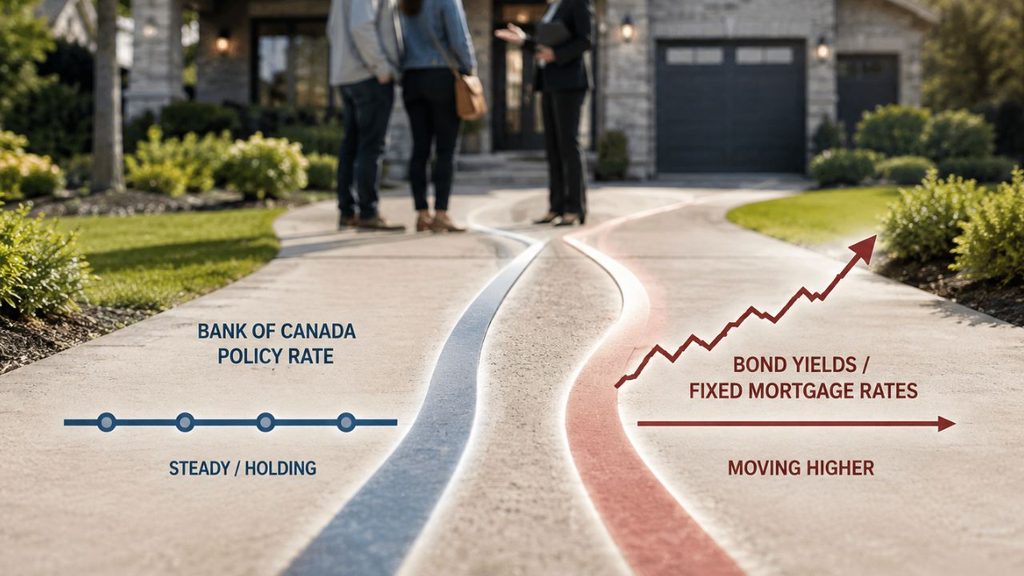
There’s another important wrinkle. The Bank of Canada directly influences variable mortgage rates. Fixed mortgage rates are much more closely connected to Government of Canada bond yields. And those yields can move even when the Bank does absolutely nothing.
The Bank specifically noted on September 2 that long-term bond yields have moved higher since July. That’s important because it means someone waiting for a Bank of Canada cut before locking in a fixed mortgage could actually watch fixed rates move higher in the meantime. The Bank’s announcement schedule is not the mortgage market’s schedule.
If your Ontario mortgage is renewing soon
This is where I would be particularly cautious about waiting. A lot of Ontario homeowners are still renewing mortgages that were originally taken during the ultra-low-rate years. Even with the Bank of Canada at 2.25%, many of those borrowers are going to see higher payments.
If your renewal is coming within the next several months, I wouldn’t base the plan on hoping October or December produces a surprise rate cut. Start looking at your options early.
A rate hold can protect you if fixed rates rise before your renewal, while still allowing us to look for something better if rates improve. We can also compare fixed and variable options rather than automatically renewing into whatever your existing lender puts in the envelope.
And please don’t assume the giant “We’ve made renewing easy!” button in your online banking means they’ve also made renewing cheap. Those are two very different services.
What if you’re buying your first Ontario home?

The same principle applies. Don’t calculate affordability using the mortgage rate you hope exists six months from now. Calculate it using numbers available today. Get properly pre-approved. Understand the payment. Leave room in the budget for property taxes, condo fees if applicable, utilities and the inevitable trip to Home Depot where you somehow spend $214 despite going in for one lightbulb.
If the home and the payment make sense now, a hypothetical future rate shouldn’t necessarily stop you. If the numbers don’t make sense now, lower rates aren’t a good excuse to stretch yourself either.
What happens next?
The Bank of Canada’s next interest-rate announcement is scheduled for October 28, along with a new Monetary Policy Report. Could the outlook change before then? Absolutely. If Canada’s economy weakens significantly and inflation pressure fades, rate cuts could come back into the conversation.
But as of September, the Bank appears considerably more concerned about upside inflation risks than it was a few months ago. That’s why I wouldn’t make an Ontario home purchase, renewal or mortgage strategy dependent on rates falling soon. There may be good reasons for you to wait. “Surely the Bank of Canada will cut soon” just shouldn’t be the only one.
If you’re buying, renewing or considering a refinance in Ontario, I can run the numbers based on today’s mortgage market and show you what the different options actually look like — without requiring anyone to predict what Tiff Macklem is going to do next.