
Buying your first home often involves compromise. While everyone dreams of moving into a perfect home, many first-time buyers in Ottawa discover that the properties within their budget need some updating. Whether it’s an older home in one of Ottawa’s established neighbourhoods with an outdated kitchen, aging flooring, an unfinished basement, or a bathroom that’s seen better days, renovations are often part of the homeownership journey.
The challenge is that after saving for a down payment, closing costs, legal fees, land transfer tax, and moving expenses, there may not be much money left for improvements. Fortunately, there are financing options that can help homeowners complete renovations without having to pay for everything upfront.
Financing Renovations Through Your Mortgage

One of the most popular solutions for first-time buyers is a Purchase Plus Improvements mortgage. This program allows buyers to finance eligible renovations as part of their mortgage when they purchase the home.
Let’s say you find a home in Ottawa for $650,000, but you know it needs approximately $25,000 worth of work. Rather than paying for those renovations entirely out of pocket after taking possession, a Purchase Plus Improvements mortgage may allow the renovation costs to be incorporated into the mortgage financing.
The lender will typically require quotes from contractors before closing and will hold back the renovation funds until the work is completed. Once the renovations are finished and verified, the funds are released.
For many buyers, this can be an attractive option because mortgage rates are generally much lower than the interest rates associated with credit cards, personal loans, or unsecured lines of credit. It can also allow buyers to consider homes that might otherwise be overlooked because they need cosmetic updates.
Another option homeowners often hear about is a Home Equity Line of Credit (HELOC). A HELOC allows homeowners to borrow against the equity they have built in their property.
What Is a HELOC?
Unlike a traditional loan, a HELOC functions more like a revolving line of credit. You can borrow funds as needed, repay them, and borrow again within your approved limit. Interest is only charged on the amount you have actually borrowed.
Many Canadians use HELOCs to finance renovations, fund large purchases, consolidate higher-interest debt, or provide flexibility for unexpected expenses.
Can First-Time Buyers Use a HELOC?
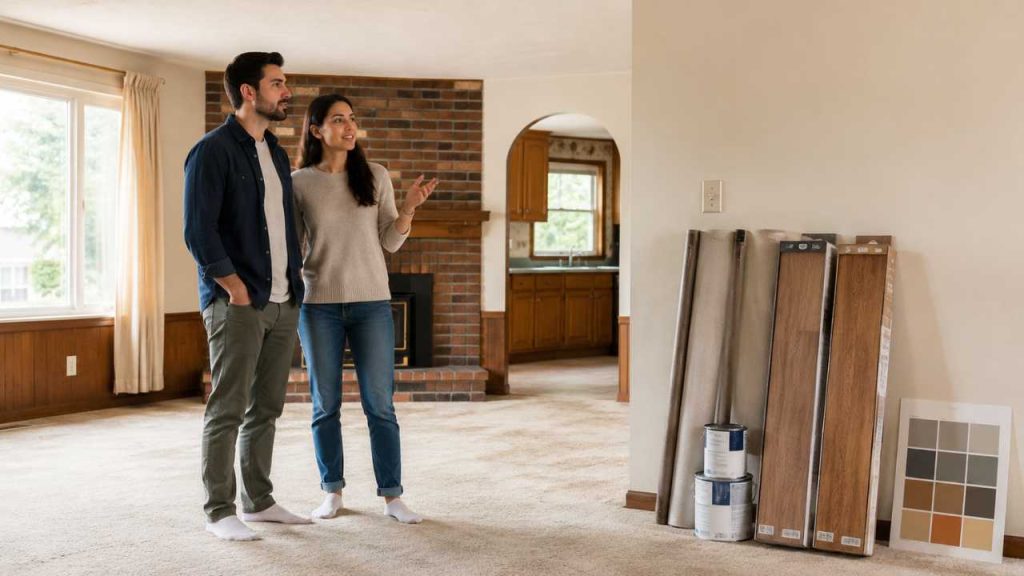
In many cases, first-time buyers are surprised to learn that a HELOC may not be available immediately after purchasing a home.
Most first-time buyers purchase with a relatively small down payment and therefore have limited equity available after closing. Since HELOCs are based on home equity, many lenders require homeowners to build equity before they can qualify for a meaningful credit limit.
This means that if you’re planning renovations shortly after purchasing a property, a Purchase Plus Improvements mortgage is often a more practical solution than a HELOC. Over time, however, as your mortgage balance decreases and your home’s value increases, a HELOC may become a useful financing tool for future upgrades.
Which Option Makes More Sense?
The right choice depends largely on when the renovations will be completed.
If you know the home needs work immediately after possession, financing the improvements through the mortgage is often the simplest and most cost-effective solution. The renovation funds are arranged upfront, and the borrowing is typically done at mortgage rates rather than higher consumer lending rates.
A HELOC is generally more suitable for homeowners who have already built equity and want the flexibility to complete projects over time. Rather than committing to all renovations at once, homeowners can access funds when needed and manage projects at their own pace.
Which Renovations Add the Most Value?
Not every renovation increases a home’s value equally. In Ottawa, some improvements tend to deliver stronger returns than others.
Kitchen and bathroom renovations continue to offer some of the best returns because they’re among the first features buyers notice when viewing a home. Replacing worn flooring, updating lighting, and applying fresh paint can also dramatically improve a home’s appearance without requiring a major investment.
Finishing a basement is another popular renovation in Ottawa, where additional living space can add significant value and functionality. Energy-efficiency upgrades—such as replacing windows and doors, improving insulation, or installing a more efficient heating and cooling system—can also help reduce utility costs while making the home more comfortable throughout Ottawa’s hot summers and cold winters.
That said, homeowners should avoid over-improving a property for the surrounding neighbourhood. Spending $100,000 on renovations doesn’t necessarily increase a home’s value by the same amount. Before taking on major projects, it’s worth discussing your plans with your realtor, contractor, and mortgage broker to better understand the potential return on investment.
Mortgage Broker Advice

Buying a home that needs a little work is often a smart way for first-time buyers to enter Ottawa’s competitive housing market. In many cases, homes requiring cosmetic updates can be purchased for less than fully renovated properties, giving buyers the opportunity to build equity while customizing the home to suit their needs.
If you know renovations will be needed immediately, a Purchase Plus Improvements mortgage may allow you to complete those upgrades without draining your savings after closing. If you’ve already owned your home for several years and have built equity, a HELOC can provide flexible access to funds for future projects.
Every lender has different rules regarding renovation financing, qualifying requirements, and available programs. Before making an offer on a home that needs work, it’s worth exploring your options so you can confidently budget for both the purchase and the improvements.
If you’re considering buying your first home in Ottawa and would like to discuss renovation financing options, I’d be happy to help you understand what’s available and determine which solution best fits your goals. Contact me for free, personalized mortgage advice.